
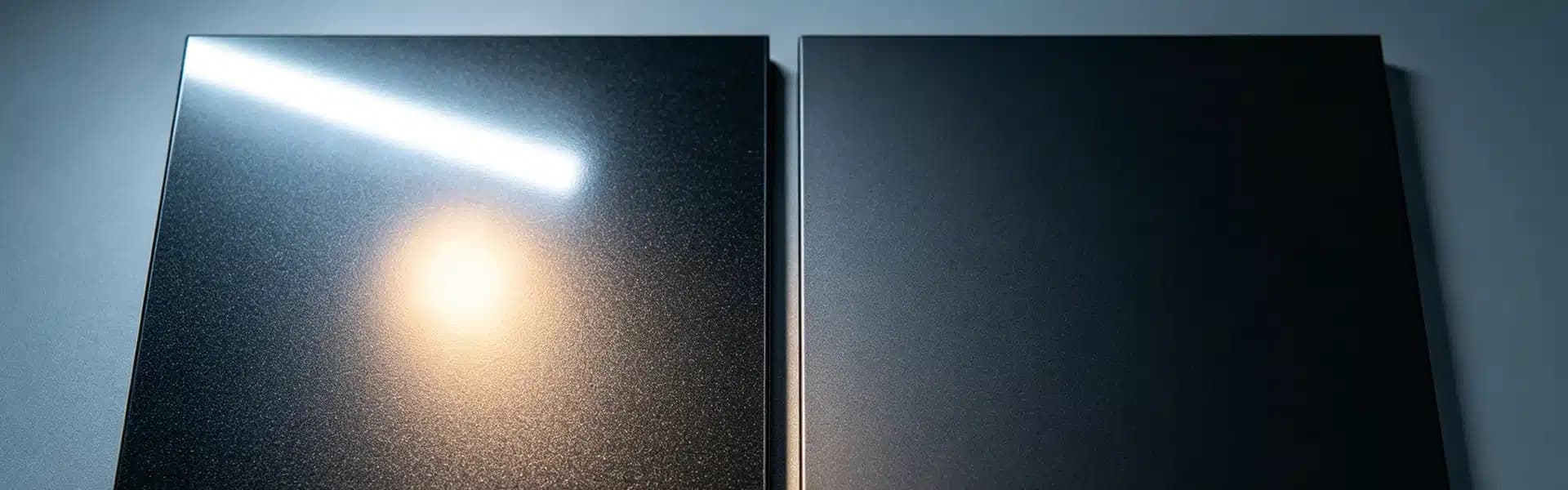
A spec-grade breakdown of silica, wax, and hybrid matting agents — covering gloss performance, chemical resistance, cost, and formulation trade-offs for industrial coatings.
GMATT
03 itemsSynthetic amorphous silica matting agents — 100 / 200 / 300 / 600 / UV / WB series. Drop-in alternatives to Evonik ACEMATT, Grace SYLOID, and AEROSIL OK.
- 01Cross-Line · Wax-treated vs Precipitated
GMATT 200 vs GMATT 600 — Cross-Line Comparison
GMATT 200 series uses surface-treated fumed silica with a primary particle size of 3–7 µm and a refractive index closely matched to most clear-coat resins (1.46).
Read - 02GMATT vs AEROSIL OK 520
GMATT vs AEROSIL OK 520 — Side-by-Side
Both GMATT 200 series and AEROSIL OK 520 are organically treated precipitated and fumed silica matting agents designed to reduce gloss in solvent-based coatings.
Read - 03GMATT vs Grace SYLOID
GMATT vs Syloid — Side-by-Side
Both GMATT and Syloid lines offer median particle sizes (D50) from 5 µm to 12 µm, but their pore volume profiles differ. Syloid C803 and C807 use a narrow-pore gel structure (pore volume ~1.0–1.2 mL/g
Read
HMMAT
25 itemsOEM / parent line of silica matting agents — same chemistry as GMATT, distributed under the HMMAT label for OEM markets.
- 01ACEMATT 3300
ACEMATT 3300 Equivalent & Alternative
Looking for a ACEMATT 3300 alternative? Compare specifications and find equivalent products with competitive pricing from China.
Read - 02ACEMATT 3400
ACEMATT 3400 Equivalent & Alternative
Looking for a ACEMATT 3400 alternative? Compare specifications and find equivalent products with competitive pricing from China.
Read - 03ACEMATT 3600
ACEMATT 3600 Equivalent & Alternative
Looking for a ACEMATT 3600 alternative? Compare specifications and find equivalent products with competitive pricing from China.
Read - 04ACEMATT 790
ACEMATT 790 Equivalent & Alternative
Looking for a ACEMATT 790 alternative? Compare specifications and find equivalent products with competitive pricing from China.
Read - 05ACEMATT 810
ACEMATT 810 Equivalent & Alternative
Looking for a ACEMATT 810 alternative? Compare specifications and find equivalent products with competitive pricing from China.
Read - 06ACEMATT 82
ACEMATT 82 Equivalent & Alternative
Looking for a ACEMATT 82 alternative? Compare specifications and find equivalent products with competitive pricing from China.
Read - 07ACEMATT HK 125
ACEMATT HK 125 Equivalent & Alternative
Looking for a ACEMATT HK 125 alternative? Compare specifications and find equivalent products with competitive pricing from China.
Read - 08ACEMATT HK 390
ACEMATT HK 390 Equivalent & Alternative
Looking for a ACEMATT HK 390 alternative? Compare specifications and find equivalent products with competitive pricing from China.
Read - 09ACEMATT HK 400
ACEMATT HK 400 Equivalent & Alternative
Looking for a ACEMATT HK 400 alternative? Compare specifications and find equivalent products with competitive pricing from China.
Read - 10ACEMATT HK 440
ACEMATT HK 440 Equivalent & Alternative
Looking for a ACEMATT HK 440 alternative? Compare specifications and find equivalent products with competitive pricing from China.
Read - 11ACEMATT HK 450
ACEMATT HK 450 Equivalent & Alternative
Looking for a ACEMATT HK 450 alternative? Compare specifications and find equivalent products with competitive pricing from China.
Read - 12ACEMATT HK 460
ACEMATT HK 460 Equivalent & Alternative
Looking for a ACEMATT HK 460 alternative? Compare specifications and find equivalent products with competitive pricing from China.
Read - 13ACEMATT HK 520
ACEMATT HK 520 Equivalent & Alternative
Looking for a ACEMATT HK 520 alternative? Compare specifications and find equivalent products with competitive pricing from China.
Read - 14ACEMATT OK 390
ACEMATT OK 390 Equivalent & Alternative
Looking for a ACEMATT OK 390 alternative? Compare specifications and find equivalent products with competitive pricing from China.
Read - 15ACEMATT OK 412
ACEMATT OK 412 Equivalent & Alternative
Looking for a ACEMATT OK 412 alternative? Compare specifications and find equivalent products with competitive pricing from China.
Read - 16ACEMATT OK 412 LC
ACEMATT OK 412 LC Equivalent & Alternative
Looking for a ACEMATT OK 412 LC alternative? Compare specifications and find equivalent products with competitive pricing from China.
Read - 17ACEMATT OK 500
ACEMATT OK 500 Equivalent & Alternative
Looking for a ACEMATT OK 500 alternative? Compare specifications and find equivalent products with competitive pricing from China.
Read - 18ACEMATT OK 520
ACEMATT OK 520 Equivalent & Alternative
Looking for a ACEMATT OK 520 alternative? Compare specifications and find equivalent products with competitive pricing from China.
Read - 19ACEMATT OK 607
ACEMATT OK 607 Equivalent & Alternative
Looking for a ACEMATT OK 607 alternative? Compare specifications and find equivalent products with competitive pricing from China.
Read - 20ACEMATT OK 607 LC
ACEMATT OK 607 LC Equivalent & Alternative
Looking for a ACEMATT OK 607 LC alternative? Compare specifications and find equivalent products with competitive pricing from China.
Read - 21ACEMATT OK 900
ACEMATT OK 900 Equivalent & Alternative
Looking for a ACEMATT OK 900 alternative? Compare specifications and find equivalent products with competitive pricing from China.
Read - 22ACEMATT OK 990
ACEMATT OK 990 Equivalent & Alternative
Looking for a ACEMATT OK 990 alternative? Compare specifications and find equivalent products with competitive pricing from China.
Read - 23ACEMATT OP 278
ACEMATT OP 278 Equivalent & Alternative
Looking for a ACEMATT OP 278 alternative? Compare specifications and find equivalent products with competitive pricing from China.
Read - 24ACEMATT TS 100
ACEMATT TS 100 Equivalent & Alternative
Looking for a ACEMATT TS 100 alternative? Compare specifications and find equivalent products with competitive pricing from China.
Read - 25ACEMATT TS 100/20
ACEMATT TS 100/20 Equivalent & Alternative
Looking for a ACEMATT TS 100/20 alternative? Compare specifications and find equivalent products with competitive pricing from China.
Read
SEMISIL
04 itemsFumed silica — H100 polyester-coating grade plus hydrophilic and hydrophobic portfolios. Equivalent to AEROSIL R-series and Cabot CAB-O-SIL.
- 01SEMISIL H100 vs Cabot CAB-O-SIL TS-720
SEMISIL H100 vs Cabot CAB-O-SIL® TS-720 — Comparison
Both are matting agents based on pdms-treated fumed silica. Specs come from each supplier’s published TDS — use them as a starting point and confirm against the COA for your specific lot.
Read - 02SEMISIL H100 vs Evonik ACEMATT OK 412
SEMISIL H100 vs Evonik ACEMATT® OK 412 — Comparison
Both are matting agents based on treated fumed silica. Specs come from each supplier’s published TDS — use them as a starting point and confirm against the COA for your specific lot.
Read - 03SEMISIL H100 vs Evonik ACEMATT TS 100
SEMISIL H100 vs Evonik ACEMATT® TS 100 — Comparison
Both are matting agents based on treated fumed silica. Specs come from each supplier’s published TDS — use them as a starting point and confirm against the COA for your specific lot.
Read - 04SEMISIL H100 vs Grace SYLOID C812
SEMISIL H100 vs Grace SYLOID® C812 — Comparison
Both are matting agents based on silica gel (precipitated, organic treated). Specs come from each supplier’s published TDS — use them as a starting point and confirm against the COA for your specific
Read
Other
01 itemPrecipitated vs. Fumed Silica: The Core Trade-Off
Precipitated and fumed silica are the two dominant matting technologies, but they serve different formulation priorities. Precipitated silica (e.g., GMATT 100/200/600 series) offers high matting efficiency at 2–5% loading with particle sizes of 3–7 µm, delivering 10–25 GU at 60° in most solventborne systems. Fumed silica (e.g., Aerosil OK 520, SEMISIL H100) provides superior transparency and anti-settling but requires higher shear dispersion and typically costs 2–3× more per kilogram.
For formulators prioritizing cost-effective gloss reduction in standard industrial coatings, precipitated silica wins. For high-clarity wood finishes or automotive clears where haze is unacceptable, fumed silica justifies the premium. See our detailed breakdown in GMATT vs. Aerosil OK 520.
Silica vs. Wax Matting Agents: When to Use Each
Silica matting agents reduce gloss by creating micro-roughness on the film surface, while wax matting agents (PE, PTFE, PP waxes) achieve low gloss through surface migration and bloom. The mechanisms are fundamentally different, and so are the performance envelopes.
Silica delivers permanent, rub-resistant matting with excellent chemical resistance — critical for industrial and protective coatings. Wax-based systems offer softer tactile feel and easier incorporation but sacrifice scratch resistance and recoatability. In many formulations, a silica-wax hybrid at 3% silica + 1% wax balances gloss, feel, and durability. Full analysis at silica vs. wax matting agents.
Synthetic Silica vs. Natural Silica (Diatomaceous Earth)
Natural silica fillers like diatomaceous earth (DE) are sometimes used as low-cost matting extenders, but they introduce significant quality trade-offs. DE particles are irregular, with broad size distributions (2–25 µm), leading to inconsistent gloss values batch-to-batch — typically ±5 GU variance compared to ±1–2 GU for synthetic precipitated silica.
Synthetic silica also delivers 30–50% better transparency in clear coats due to controlled porosity and refractive index matching. For any specification requiring <15 GU at 60° with consistent batch quality, synthetic precipitated or gel silica is the only reliable path. DE remains viable only in pigmented primers where haze and gloss consistency are non-critical.
GMATT vs. Syloid: Precipitated Silica Head-to-Head
Both GMATT and Syloid (Grace/Evonik) are precipitated silica lines targeting the same formulation space — solventborne and waterborne industrial coatings. GMATT 100 series offers comparable matting efficiency to Syloid C803/C809 at 3–5% loading, achieving 8–15 GU at 60° in alkyd and polyurethane systems.
Key differentiators are pore volume, oil absorption, and price. GMATT typically provides 10–15% lower oil absorption, which means less impact on viscosity at equivalent loading. Pricing for GMATT runs 15–25% below Syloid in most Asian and Middle Eastern markets, making it the value play without sacrificing spec compliance. Detailed data at GMATT vs. Syloid.
Quick Selection Specs by Matting Type
Use this table to shortlist the right matting technology for your system before requesting samples.
| Property | Precipitated Silica | Fumed Silica | Wax (PE/PTFE) | DE (Natural) |
|---|---|---|---|---|
| Gloss range (60°) | 5–25 GU | 8–30 GU | 15–40 GU | 20–50 GU |
| Typical loading | 2–5% | 1–3% | 1–3% | 5–10% |
| Transparency | Good | Excellent | Good | Poor |
| Chemical resistance | Excellent | Excellent | Fair | Fair |
| Scratch resistance | High | High | Low–Medium | Low |
| Batch consistency | ±1–2 GU | ±1 GU | ±2–3 GU | ±5 GU |
| Relative cost (index) | 1.0× | 2–3× | 0.8–1.2× | 0.3–0.5× |
Frequently Asked Questions
Common questions about comparison.
+What is the most cost-effective matting agent for industrial coatings?
Precipitated silica is the most cost-effective matting agent for industrial coatings. At 2–5% loading it achieves 5–25 GU at 60° with excellent chemical and scratch resistance, at roughly half the cost of fumed silica per unit of gloss reduction.
+Can I mix silica and wax matting agents in the same formulation?
Yes, silica-wax hybrids are common and effective. A typical blend of 3% precipitated silica plus 1% PE wax delivers low gloss with improved surface feel. The silica provides permanent matting and scratch resistance while the wax adds slip and soft touch.
+Why is fumed silica more expensive than precipitated silica?
Fumed silica is produced by flame hydrolysis of silicon tetrachloride at 1000–1800 °C, an energy-intensive process yielding ultra-fine primary particles (7–40 nm). Precipitated silica uses wet-process chemistry at lower temperatures, making it 2–3× cheaper per kilogram at comparable purity.
+What particle size should I target for matting agents in clear coats?
Target 3–5 µm median particle size for clear coats. Particles below 3 µm reduce matting efficiency, while particles above 7 µm increase haze and surface roughness. For premium clear coats, fumed silica at 1–2% loading provides the lowest haze at acceptable gloss levels.
+How does oil absorption affect matting agent selection?
Higher oil absorption means the matting agent absorbs more resin, increasing viscosity and potentially reducing film gloss efficiency. GMATT’s 10–15% lower oil absorption versus comparable Syloid grades allows higher loading before viscosity limits are reached, giving formulators more flexibility.
+Is diatomaceous earth a viable alternative to synthetic silica matting agents?
Only in non-critical applications like pigmented primers. Diatomaceous earth costs 50–70% less but delivers poor batch consistency (±5 GU), low transparency, and weak chemical resistance. Any spec requiring <15 GU at 60° or consistent quality should use synthetic silica.
For most industrial coatings requiring <20 GU at 60°, precipitated silica at 3–5% loading delivers the best balance of matting efficiency, transparency, and cost. Reserve fumed silica for high-clarity applications and wax hybrids for tactile-critical surfaces.
Matting Agent Comparisons — grade recommendation & samples.
Submit formulation targets (gloss, system, DFT, volume). A SEMITECH chemist will recommend the right grade and ship a lab sample.