
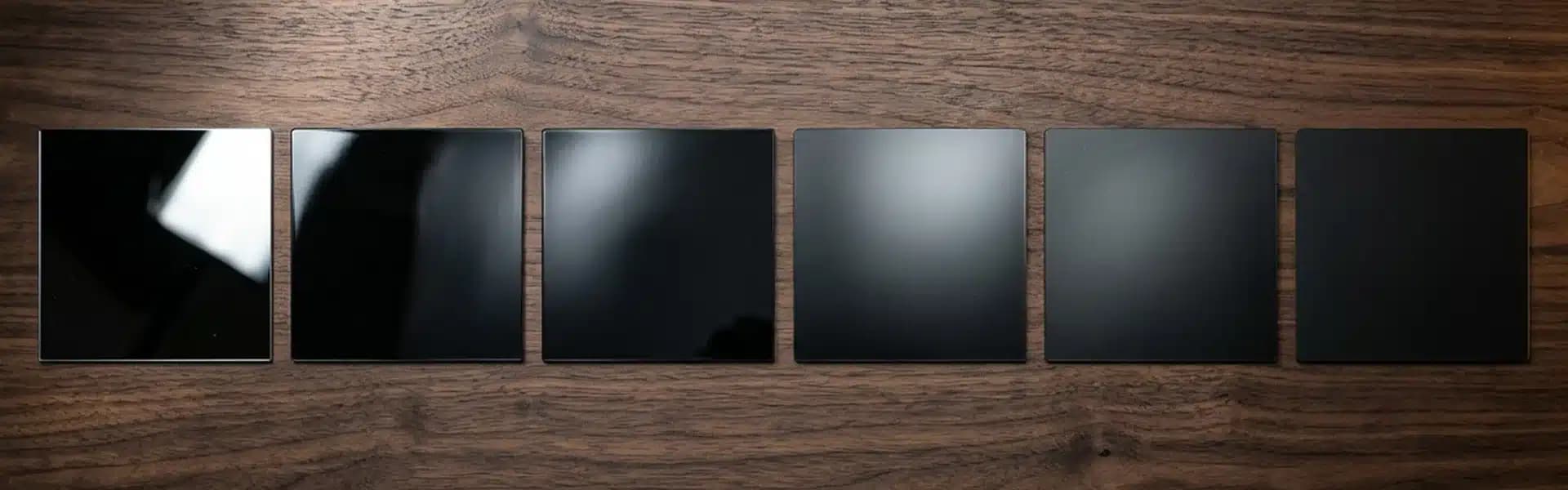
A decision-tree framework for selecting matting agents by resin system, target gloss, coating thickness, and performance requirements.
- 01Selection · By Dry Film Thickness
Choose by Coating Film Thickness
In coatings under 25 μm dry film thickness (DFT), matting agent particles must be small enough to protrude from the surface without compromising film integrity.
Read - 02Selection · By Resin System
Choose by Resin System
Thermoplastic systems cure by solvent evaporation, so the matting agent must disperse quickly without extended high-shear mixing. For acrylic coatings, GMATT 200 series (D50 5–7 µm, pore volume 1.6 mL
Read - 03Selection · By Target Gloss
Choose by Target Gloss Level
Achieving below 5 gloss units at 60° demands large-particle precipitated silica (D50 8–12 µm) at high loadings of 4–6% by weight. GMATT 600 Series grades are purpose-built for this range, delivering a
Read - 04Selection Guide · Waterborne Conversion
Converting from Solvent to Waterborne — Matting Considerations
A practical grade swap matrix for formulators converting solvent-borne systems to waterborne, covering dosage shifts, foam risks, and redispersion benchmarks.
Read - 05Selection Guide · Cost Vs Performance
Cost vs Performance Trade-offs
Precipitated silica covers 60–70% of industrial matting needs at roughly half the cost of fumed grades — here is where each grade earns its price.
Read - 06Selection · Anti-settling First
When Anti-Settling is the Top Priority
Most gel-type silica matting agents are optimized for gloss reduction efficiency, not suspension stability. Grades with D50 above 10 µm and low surface area (<150 m²/g) settle within weeks in low-visc
Read - 07Selection Guide · Chemical Resistance Needs
When Chemical Resistance Drives the Choice
In tank linings and secondary containment, only pure synthetic silica matting agents survive prolonged chemical exposure — wax and PP alternatives fail within months.
Read - 08Selection Guide · High Scratch Priority
When Scratch Resistance Drives Selection
Narrow PSD and wax-treated grades cut Taber abrasion loss by 30–50% versus standard matting silica — here is what formulators should specify.
Read - 09Selection Guide · Transparency Requirements
When Transparency is Critical
Particle size below 3 µm and refractive index near 1.46 are the two non-negotiable specs for matting agents in transparency-critical clear coatings.
Read
Select by Resin System
Resin chemistry is the first filter in matting agent selection. Precipitated silica (d50 3–5 µm) works across most solventborne systems — polyurethanes, alkyds, acrylics — but performance diverges sharply in waterborne and UV-cure formulations. Waterborne coatings demand surface-treated grades with hydrophobic modification (C8 or wax-treated) to prevent moisture-driven re-agglomeration during storage. UV-cure systems require sub-4 µm particles with minimal UV absorption to avoid curing interference.
See our full resin-by-resin breakdown in the resin system guide.
Select by Gloss Target
Target gloss level determines both the grade and loading level of your matting agent. Achieving < 10 GU (dead matte) in a 30 µm DFT typically requires 8–12% loading of a large-particle precipitated silica (d50 8–12 µm), while a satin finish at 30–40 GU needs only 3–5% of a finer grade (d50 3–5 µm). Fumed silica delivers ultra-low gloss at lower loadings but at 3–5× the cost per kilogram.
Compare loading curves and cost trade-offs in the gloss target guide.
Select by Coating Thickness
Film thickness constrains particle size selection directly: the d99 of your matting agent must stay below 60–70% of dry film thickness to avoid surface defects and seed. For thin coils coatings at 15–20 µm DFT, this means d99 ≤ 12 µm — ruling out most standard grades. Thick industrial coatings at 80–120 µm can tolerate coarser particles, unlocking cheaper large-particle options.
Match your DFT range to the right grade in the coating thickness guide.
Cost vs. Performance Trade-offs
Precipitated silica remains the workhorse at $2,500–4,000/ton, covering 70%+ of industrial matting applications. Gel-type silicas offer superior transparency at $5,000–7,000/ton for clear coats. Fumed silica ($12,000–18,000/ton) is justified only where thixotropy, anti-settling, and matting are needed simultaneously — consolidating two additives into one. Wax-coated precipitated grades ($3,500–5,500/ton) reduce viscosity impact by 20–30% versus untreated equivalents, improving spray application.
Frequently Asked Questions
Common questions about selection guide.
+What is the most important factor in matting agent selection?
Resin system compatibility is the primary filter. An incompatible matting agent causes defects regardless of particle size or loading. Start by matching your binder chemistry — solventborne, waterborne, or UV-cure — to the correct silica surface treatment before optimizing for gloss or cost.
+How much matting agent do I need for a matte finish below 10 GU?
Achieving below 10 GU at 60° in a 30 µm film typically requires 8–12% loading of precipitated silica with d50 of 8–12 µm. Exact loading depends on resin type, film thickness, and application method. Fumed silica can reach the same gloss at 4–6% but costs significantly more.
+Can I use the same matting agent in waterborne and solventborne coatings?
Generally no. Standard untreated precipitated silica performs well in solventborne systems but re-agglomerates in waterborne formulations, causing gloss drift and sedimentation. Waterborne systems require hydrophobically modified grades (wax-treated or C8-functionalized) to maintain dispersion stability.
+Why does particle size matter for thin film coatings?
Particle d99 must stay below 60–70% of dry film thickness to prevent surface roughness and seed defects. A 20 µm coil coating needs d99 ≤ 12 µm, eliminating standard 6–8 µm median grades whose d99 exceeds 15 µm. Always check d99 on the TDS, not just d50.
+Is fumed silica worth the higher cost as a matting agent?
Fumed silica at $12,000–18,000/ton is 3–5× more expensive than precipitated alternatives. It is justified when you need simultaneous matting, thixotropy, and anti-settling in one additive — replacing two separate products. For matting-only applications, precipitated silica is more cost-effective.
+How do I prevent gloss drift during storage?
Gloss drift results from matting agent settling or re-agglomeration over time. Use surface-treated grades matched to your binder polarity, ensure adequate dispersion energy during manufacturing (Hegman ≥ 5), and verify stability with 50°C accelerated storage tests at 4-week intervals.
Start with resin system to eliminate incompatible chemistries, then narrow by gloss target and film thickness — most formulations converge on 2–3 candidate grades within this framework.
Matting Agent Selection Guide — grade recommendation & samples.
Submit formulation targets (gloss, system, DFT, volume). A SEMITECH chemist will recommend the right grade and ship a lab sample.